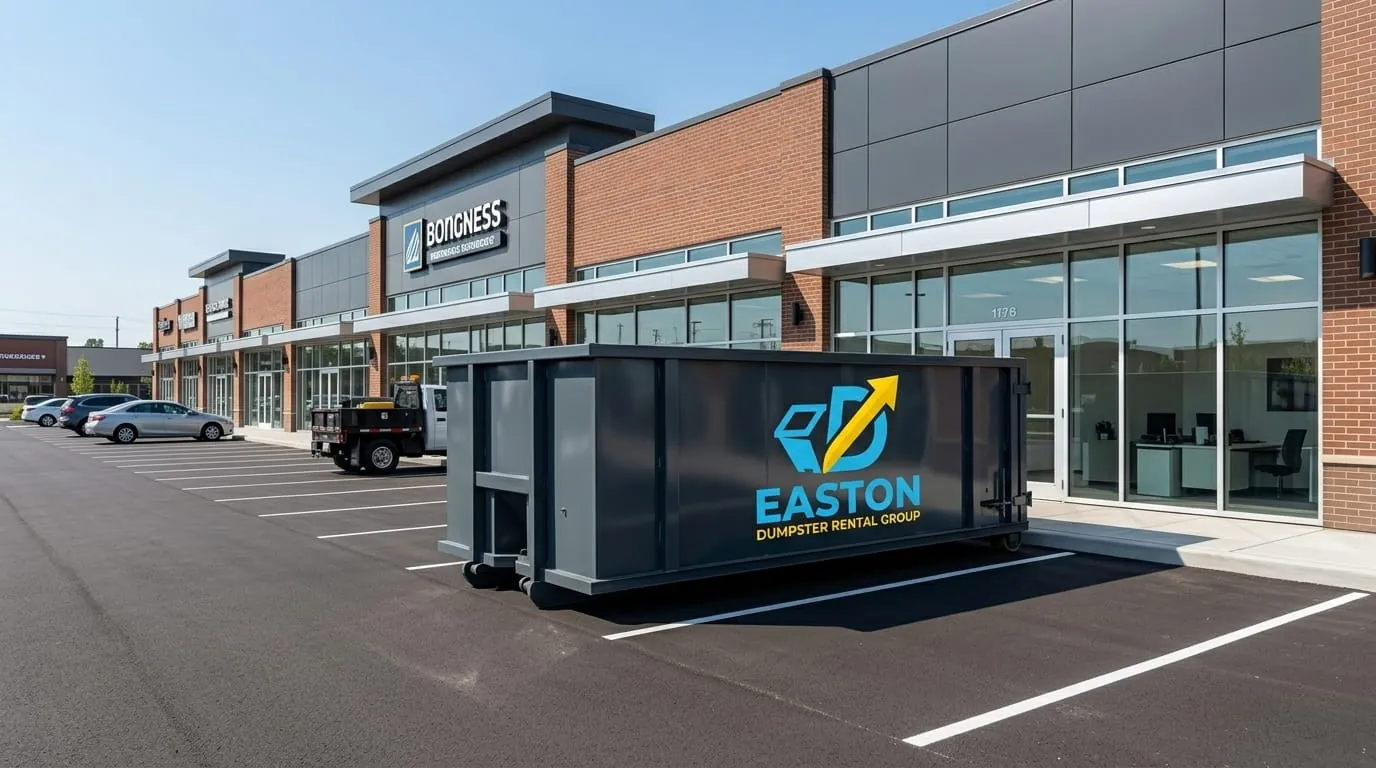
Of every job we drop a container for around Easton and the Lehigh Valley, roofing is the one where people get the size wrong most often. Not because they aren't paying attention. It's because a roof lies to you. It looks like a light, papery pile of old shingles, and then the tear-off starts and the box fills the driveway with the deadest, heaviest material we haul all year. I've watched a homeowner order a 20-yard for a job that should have gone in a 12, and I've watched a contractor stuff a two-layer tear-off into a 10-yard and blow through the weight limit before it was three-quarters full. Both cost money that never needed to be spent.
So let's do this the way we'd talk it through on the phone. What roofing debris actually weighs, why it's so dense, how single versus multi-layer changes everything, and why the 10-to-15 yard range is the sweet spot for almost every shingle job in this area. If you're on an older place in Bethlehem, Nazareth, or the historic parts of Easton, stay with me to the end, because slate and stacked layers change the math completely.
The shingle weight math, done the simple way
Roofers measure in squares. One square covers 100 square feet of roof. A bundle is a fraction of a square, and for most architectural (dimensional) shingles it takes three bundles to make one square. That's your first conversion:
- 3 bundles = 1 square = 100 sq ft of roof surface
- A bundle of architectural shingle runs roughly 65 to 80 lbs coming off the truck new
- A square of new architectural lands around 230 to 400 lbs depending on the product
But you're not throwing away new shingle. You're throwing away tear-off, which is heavier than the number on the wrapper, because it's soaked with years of weather, carrying embedded grit, old felt, drip edge, and a fistful of nails per square. The working number we use, and the one that keeps people out of trouble, is this: a single layer of asphalt tear-off weighs about 250 pounds per square. Some crews quote 200, some 300 for the heavy dimensional stuff. Use 250 and you'll rarely be surprised.
Now put a real roof to it. A typical Lehigh Valley ranch or Cape has maybe 15 to 20 squares of roof. A larger colonial or a place with a lot of dormers and hips can run 25 to 35. Do the arithmetic:
- 18 squares, single layer: 18 x 250 = 4,500 lbs, about 2.25 tons
- 25 squares, single layer: 25 x 250 = 6,250 lbs, a little over 3 tons
- 18 squares, two layers: roughly 9,000 lbs, 4.5 tons, and now you have a problem
That last line is the one that catches people. Double the layers, double the tonnage, and a lot of homeowners have no idea how many layers are up there until the first course comes off.
Why roofing debris is so much heavier than it looks
Asphalt shingle is basically a fiberglass or felt mat saturated with asphalt and coated in mineral granules. That's rock, tar, and glass, and none of it is light. Volume-wise a full container of shingle barely looks full, because the material packs flat and dense with almost no air in the pile. Compare that to a deck tear-out or a garage cleanout, where a mound of lumber and junk fills the box visually long before it comes anywhere near the weight limit.
This is the whole reason roofing gets its own conversation. With most debris, you run out of room before you run out of weight. With shingle, it's the reverse every single time. You will hit the tonnage cap with the container looking two-thirds empty, and that's normal, and it's exactly why you don't want a big box you can't fill anyway. A dedicated roofing dumpster rental is priced and weight-rated around this reality, so you're not paying for cubic yards of air you'll never use.
Single layer versus multi-layer tear-off
Pennsylvania code generally allows two layers of asphalt shingle on a roof before a full tear-off to the deck is required. So around here you meet three situations, and each one sizes differently.
Single-layer tear-off. The cleanest case. One layer of asphalt comes off down to the sheathing. Weight is predictable at that 250-lbs-per-square number, and most single-family roofs land comfortably in a 10 or 15-yard box.
Two-layer tear-off. Somebody roofed over the original at some point, which was common and legal, and now both layers come off at once. Your tonnage doubles. An 18-square roof that would have been an easy single haul is now pushing 4.5 tons, and you're either going to a larger container with a higher weight allowance or planning a swap.
Three-plus layers, or a surprise. On older Valley homes we still pull roofs with three layers of asphalt, sometimes over the remains of the original wood shake or slate. Nobody planned for it, the tonnage is off the chart, and this is where an honest phone call before the tear-off saves the whole budget. Tell us what you find in the first hour and we'll adjust the container to it.
Not sure how many layers are up there? Pull one shingle back at a rake edge before you order, or just call and describe the house. Talk it through with us at (484) 544-4458 and we'll match the box to the actual load, not the guess.
Why 10 to 15 yards is the roofing sweet spot
Here's the thing people miss: for shingle, the useful limit is weight, not volume, so a bigger dumpster does almost nothing for you. A 20 or 30-yard box holds more cubic yards, but you'll cap out on tonnage long before you fill that space, and you'll have paid a premium for capacity you physically cannot use with roofing debris.
That's why the 10, 12, and 15-yard containers are the workhorses for tear-offs. They're built low and heavy-duty, they sit compact on a driveway, and their weight allowances are set for exactly this kind of dense material. As a rough guide:
- 10-yard: right for a garage, small ranch, or a single-layer job up to roughly 15 squares
- 12 to 15-yard: the standard call for most full-house single-layer tear-offs, 15 to 30 squares
- Two layers or a big colonial: a 15-yard with a solid tonnage allowance, or a plan to swap
For the bread-and-butter Lehigh Valley roof, the 15-yard dumpster is what we drop more than any other. It holds the debris, it doesn't hog the driveway, and its weight rating is sized for shingle instead of set up for light bulky junk.
Driveway placement for roofers
Placement matters more on roofing than on almost any other job, because the whole point is to tear off and drop straight into the box. Get the container in the wrong spot and your crew is carrying tear-off across the yard by hand, which is slow, expensive, and murder on a lawn.
- Put it under the biggest roof plane. Position the box below the longest run of roof so debris slides or gets tossed straight in, not carried around the house.
- Protect the driveway. A couple sheets of plywood under the wheels and rails spreads the load and keeps a loaded box from marking the asphalt or a soft concrete apron. We do this as a matter of course.
- Leave overhead clear. The truck lifts the container high to set and pull it, so we need clearance under low branches, service wires, and eaves.
- Think about the swing. Give us a straight, firm approach. Soft spring ground or a tight turn can be the difference between an easy set and a rescheduled delivery.
Swaps on the big jobs
On a two or three-layer tear-off, or a large multi-plane roof, one container often can't legally carry the whole load. That's where a swap comes in: your crew fills the box, we haul it, weigh it, and bring back an empty so the tear-off never stops. It keeps the job moving and keeps every load under its road-legal weight, which matters, because an overloaded roll-off can't be transported and nobody wants that phone call at four in the afternoon.
If we know up front that a job is big, we plan the swap into the schedule instead of scrambling for it. Give us the square count and the layer count when you book and we'll tell you honestly whether it's one box, a bigger box, or a box-and-a-swap.
Older Lehigh Valley homes: slate and stacked layers
The Valley is full of century-old housing stock, and those roofs come with their own rules. Two things to watch.
Slate. If you're tearing off a genuine slate roof, throw the asphalt math out the window. Slate is stone. A square of slate can run 700 to 1,000-plus pounds, three or four times the weight of asphalt, and it will bottom out a weight allowance fast. Slate tear-offs almost always mean a smaller container run to a strict tonnage limit, and often a swap. This is a call-first job, every time.
Stacked history. On these older Easton, Bethlehem, and Nazareth homes, we routinely find asphalt over asphalt over the original wood or slate. What looks like a simple re-roof turns into a full deck-down tear-off with decades of material. If your house predates the war, assume more layers than you can see and price the container accordingly.
None of this is complicated once you know the one rule that governs all of it: roofing is a weight game, not a volume game. Size to the tonnage, keep the box where the crew can reach it, and plan a swap if the layers stack up. Do that and the disposal end of your roof becomes the part of the project you never have to think about twice. Any doubt about square count, layers, or which box fits your driveway, get us on the phone or reach out through our contact page and we'll settle it in five minutes.

Founder, Easton Dumpster Rental Group — sharing straight advice from more than 15 years of local hauling experience.
Frequently Asked Questions
What size dumpster do I need for a typical roof tear-off?
For most single-family homes in the Lehigh Valley with a single layer of asphalt shingle, a 10 to 15-yard container is the right call. A small ranch or garage often fits a 10-yard, while a full-house tear-off of 15 to 30 squares usually goes in a 15-yard. Because shingle is so dense, a larger box rarely helps, you hit the weight limit long before you fill the space. Tell us your rough square count and layer count and we'll match it exactly.
How much does a square of shingle tear-off weigh?
Plan on roughly 250 pounds per square for a single layer of asphalt tear-off. That's heavier than new shingle because old material is weathered, gritty, and carries felt and nails. An 18-square single-layer roof runs about 4,500 pounds, or 2.25 tons. Two layers roughly doubles that. Slate is in another category entirely, often 700 to 1,000-plus pounds per square.
Why is roofing debris so heavy compared to other junk?
Asphalt shingle is a mat saturated with asphalt and coated in mineral granules, essentially rock and tar with almost no air in the pile. It packs flat and dense, so the container looks two-thirds empty when it hits its weight limit. With most debris you run out of room first, with shingle you run out of weight first, every time. That's why roofing gets its own sizing conversation.
Can I put two layers of shingle in one dumpster?
Sometimes, but a two-layer tear-off roughly doubles the tonnage, so you may exceed the container's weight allowance. On an average roof, two layers can push 4.5 tons or more. Depending on the size of the house we'll either put you in a container with a higher weight allowance or plan a swap, where we haul the full box and drop an empty so the work never stops. Call with your layer count and we'll plan it right.
Do you handle slate roof disposal?
Yes, but slate needs its own plan. Slate is stone and weighs three to four times what asphalt does, so it caps out a weight limit fast. We typically run a smaller container to a strict tonnage limit and often schedule a swap. If you're tearing off a slate roof on an older Easton or Bethlehem home, call us first at (484) 544-4458 so we can size it to the real weight instead of guessing.